
When the power goes out in a winter storm, your alarm panel, door readers, intercom and gate keep working only as long as their backup batteries do. Those batteries sit out of sight for years, and most people learn they are worn out on the night they are needed. A short service visit before winter finds the weak ones while replacing them is still easy. This guide explains what a technician checks, how backup power is sized, and what to look at on UPS units, generators and solar-powered gates.
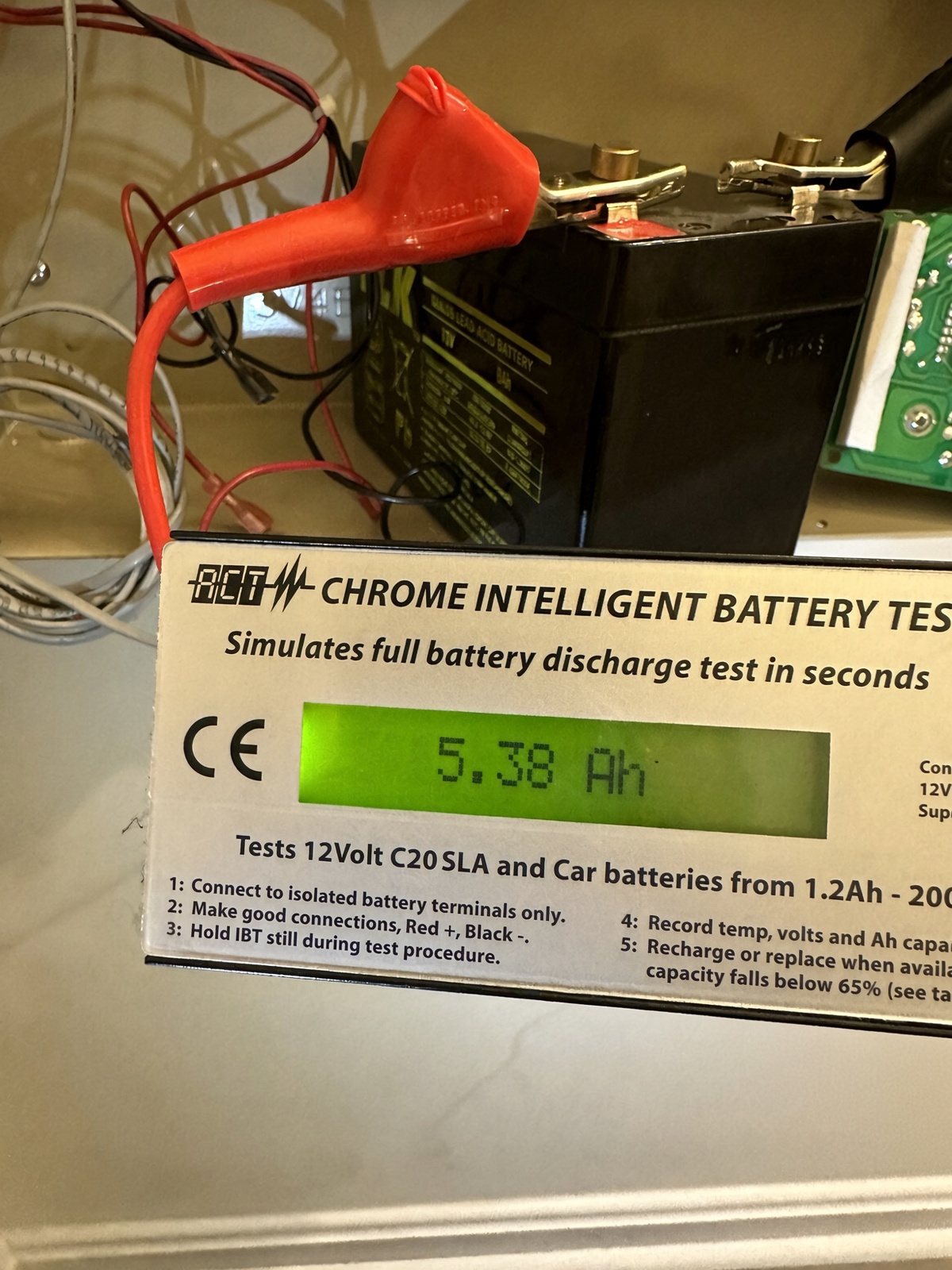
An 8 Ah Battery That Tests at 5
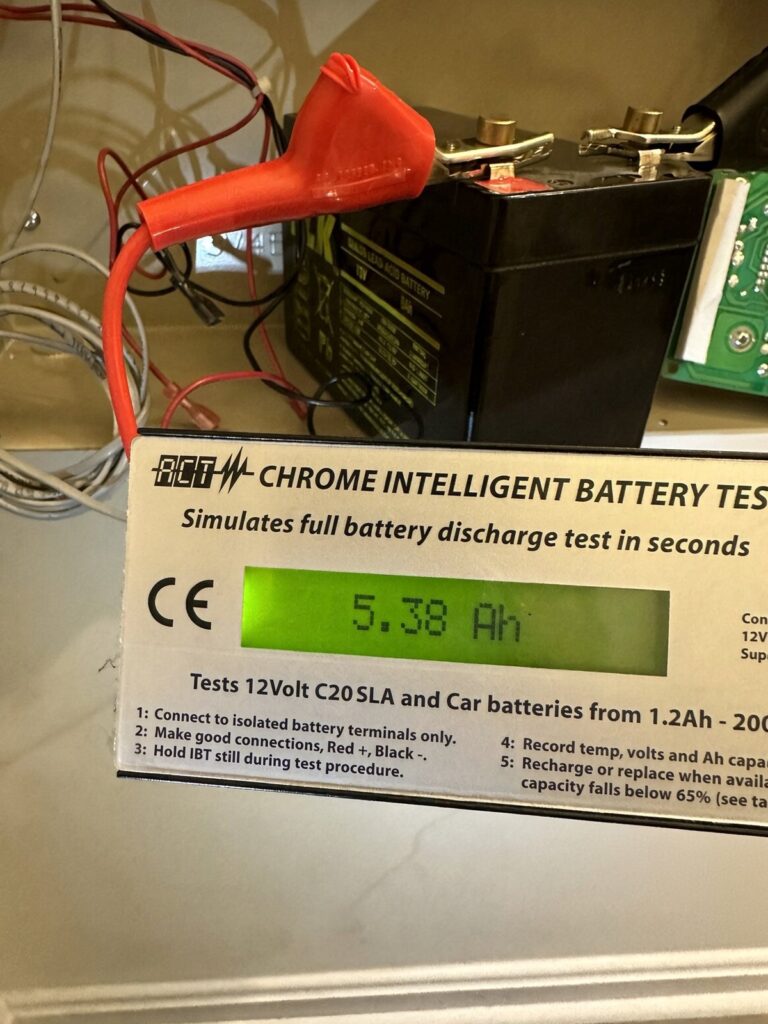
The photo above is from a service call. The battery is labeled 12 volts, 8 amp-hours. Under test it delivered 5.38 Ah, about 67% of its rating. A voltage reading alone can miss this, because a tired battery can still show a normal voltage while it sits on charge. Capacity is what matters, and capacity is what a proper tester measures.
The tester in the photo reports the amp-hours a 12-volt sealed battery can still deliver, and its maker says to recharge or replace a battery when that figure falls below 65% of the stated capacity (ACT Meters product sheet). At 67%, this one was close to the line going into winter.
Why Backup Batteries Fade
Most security equipment uses sealed lead-acid batteries. They wear out with age and heat, and they deliver less in the cold:
- Age. Altronix, which makes many access control power supplies, states an expected battery life of five years and recommends changing batteries in four years or less if needed (Altronix AL600ULXB guide). Battery maker Power-Sonic says a battery kept on standby charge at room temperature should last four to five years before its capacity drops to 60% of the original rating (Power-Sonic technical manual).
- Heat. The same manual says battery life is halved for each 10°C (18°F) above normal room temperature. A power supply in a hot mechanical room or an attic ages faster than the label suggests.
- Cold. Power-Sonic puts a sealed lead-acid battery at about 45% of its rated capacity at 0°F (Power-Sonic). Batteries in gate operators, unheated garages and outdoor enclosures have the least to give when storms arrive.
Our rule of thumb is simple: test every year, and replace at five years even if the battery still tests acceptably.
What a Battery Service Visit Covers
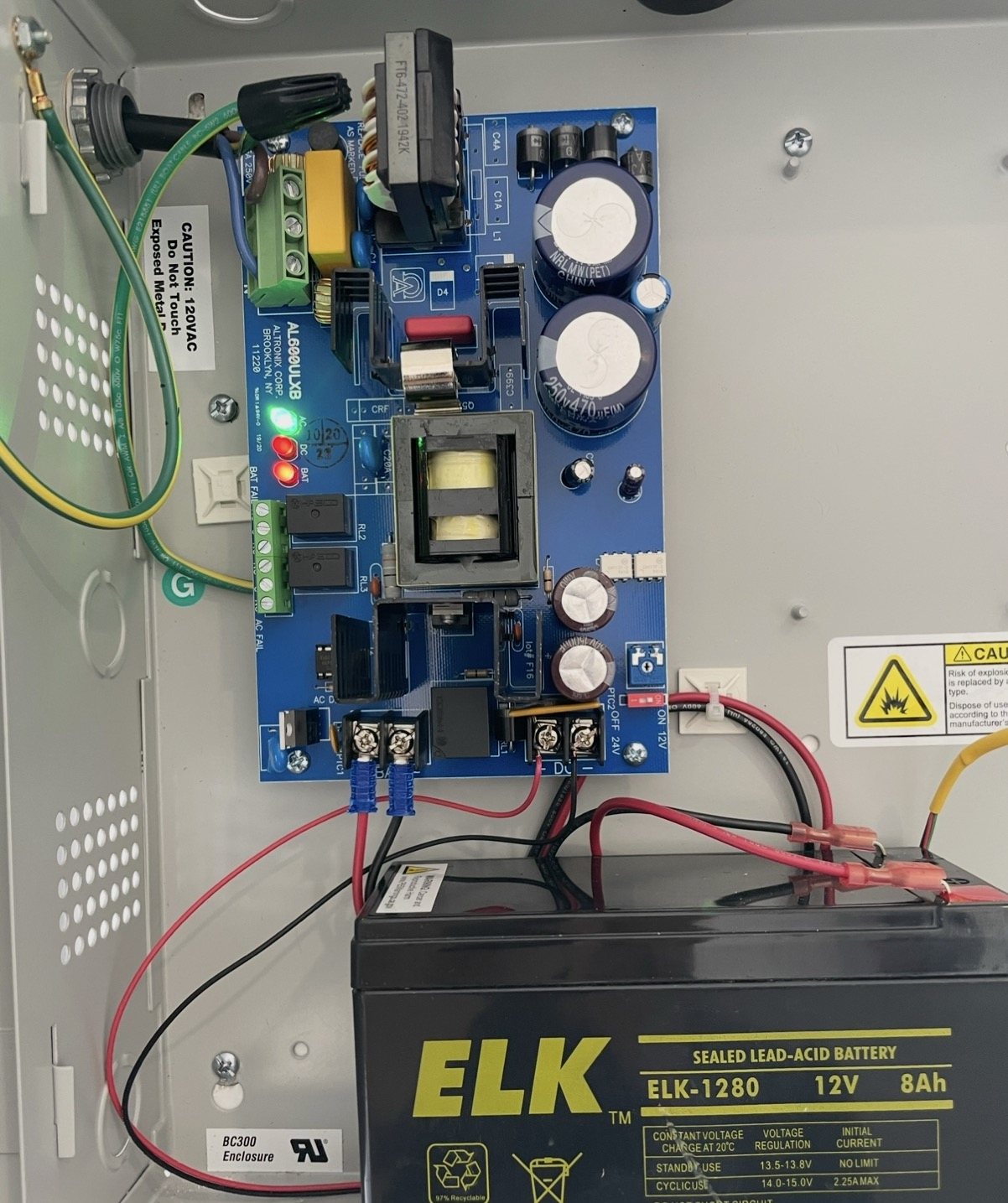
- Capacity test of each battery with a tester, not only a voltage reading.
- Current draw. We measure what the system actually draws, which is often more than when it was installed because readers, locks and cameras were added later.
- Charger and power supply check: charging voltage, AC and battery indicator lights, fuses and terminals.
- Transformers. Many alarm panels run on a plug-in transformer. DSC’s wiring instructions say not to connect it to a receptacle controlled by a switch (DSC installation manual), and Honeywell calls for a 24-hour, uninterrupted outlet (Honeywell VISTA manual). We check that the transformer is the right rating, is secure in the outlet and has not been moved to a power strip.
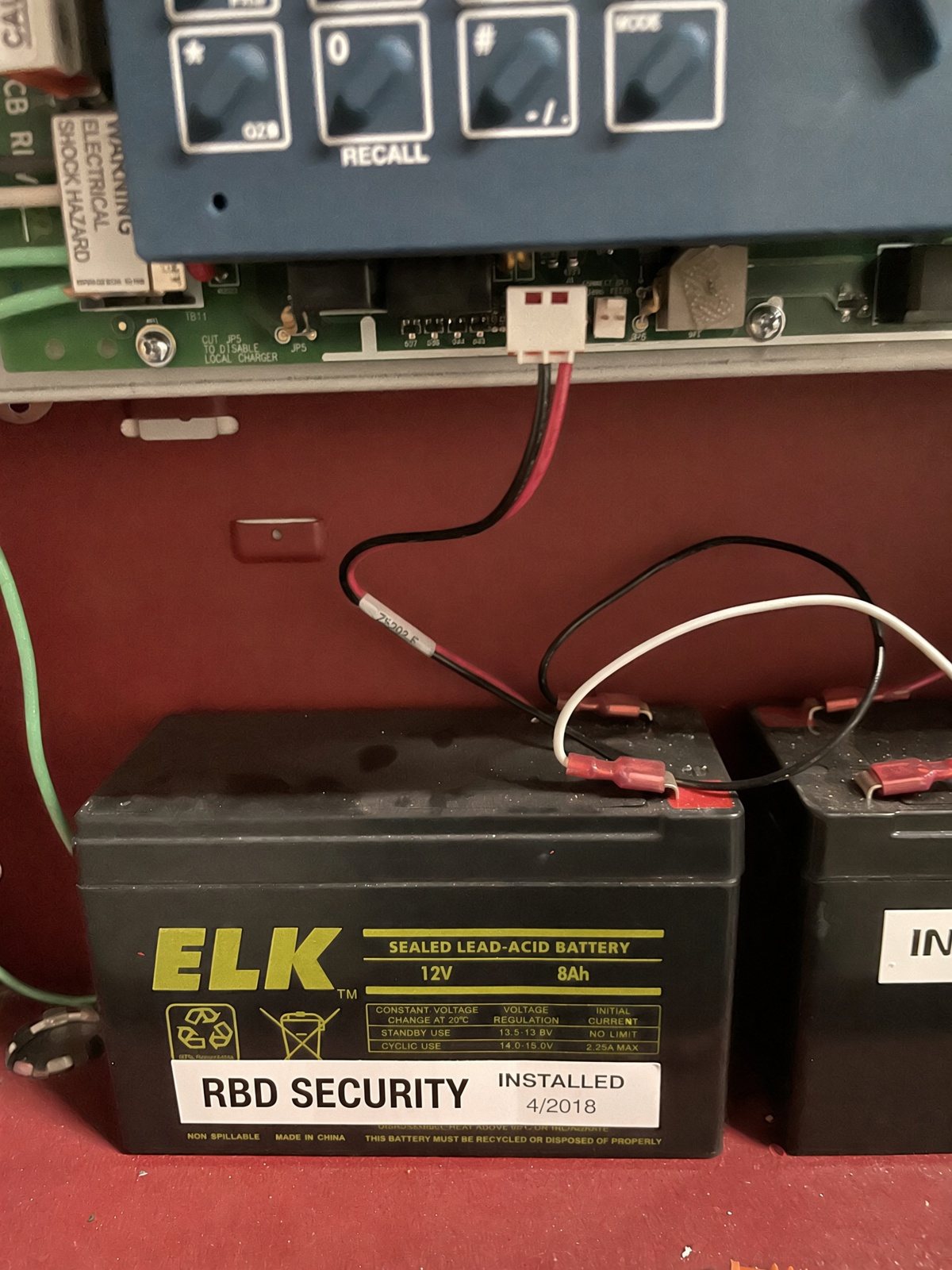
- A dated label on every battery, showing who installed it and when, so the next person can see its age at a glance.
- A real outage test: with AC disconnected, do the doors, the panel and the communicator still work?
How Backup Power Is Sized
A battery is sized from two numbers: how much current the system draws, and how long it has to run without power. The trade formula is standby current multiplied by standby hours, plus the current drawn in alarm, with a safety margin of 20 to 25% on top (Security Sales & Integration).
How many hours depends on the system:
| System | Typical standby requirement | Source |
|---|---|---|
| Fire alarm | 24 hours of standby, then 5 minutes of alarm (15 for voice systems), plus a 20% margin | EC Magazine on NFPA 72 |
| Household burglar alarm | 4 hours | ELK, citing UL 1023 |
| Access control | From none to 4 hours, depending on the UL 294 level specified | Hirsch, UL requirements |
Then comes derating. A battery that has aged to 5 Ah gives roughly five-eighths of the run time the original calculation promised, and less again in the cold. That is why the calculation includes a margin, and why the margin runs out if batteries are never replaced.
For access control there is one more question: what should each door do when the battery is finally empty? Some locks unlock without power and some stay locked. Decide that on purpose, door by door, with exits always free.
Battery Types
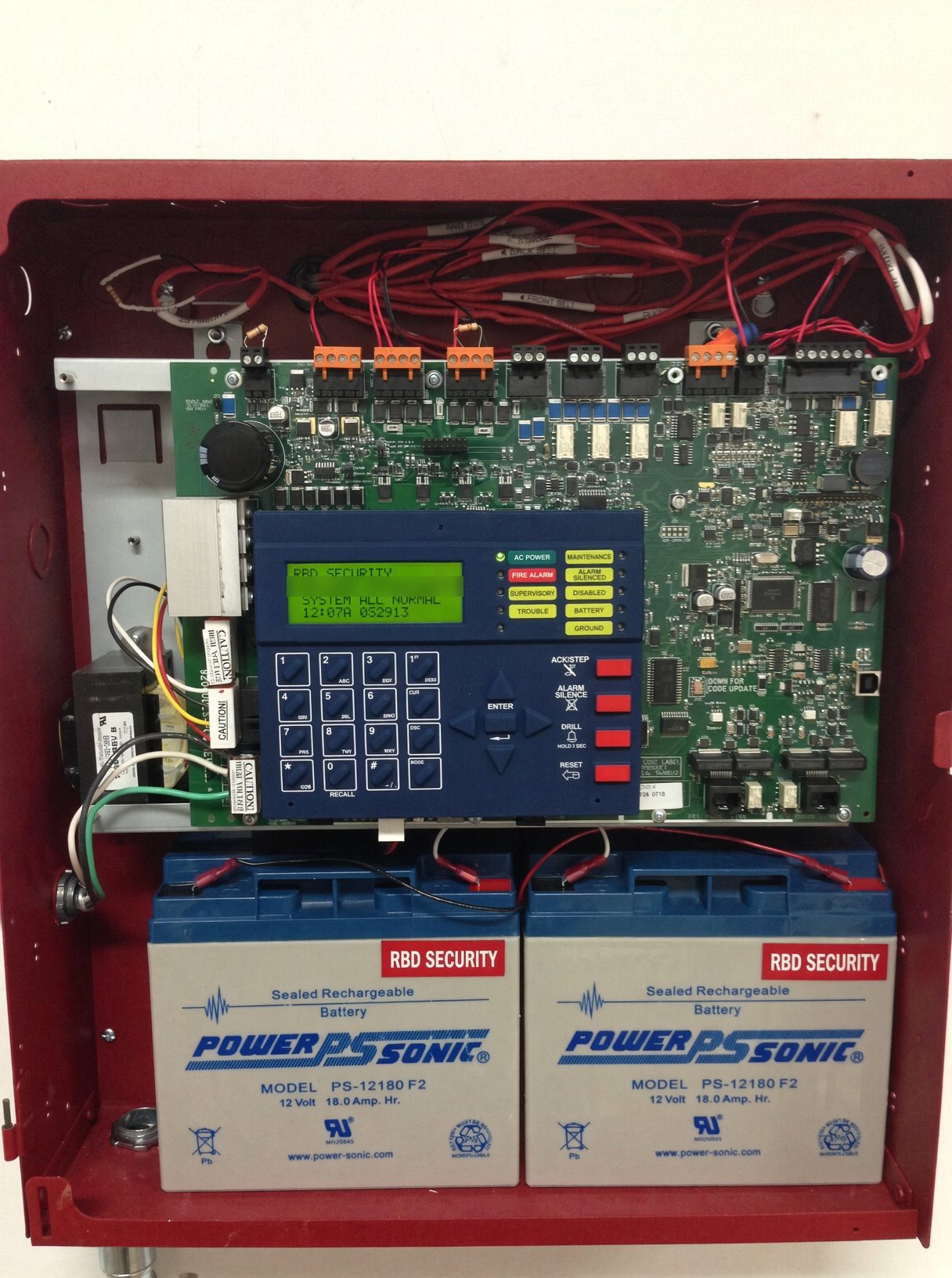
- Sealed lead-acid (AGM). The standard in alarm panels and power supplies. It has to stay on a float charge to be ready (Power-Sonic).
- Gel. A similar sealed battery with gelled acid. Power-Sonic notes it does not perform as well as AGM in high-rate use (Power-Sonic).
- Lithium iron phosphate. Lighter, and it holds more of its capacity in the cold, but it will not accept a charge below 32°F, and the charger has to suit the chemistry (Power-Sonic).
Replace like with like unless the equipment maker approves a different type.
UPS Units
Network switches, recorders, access control servers and intercom controllers often sit on a UPS. Its batteries wear the same way:
- APC says most of its batteries last three to five years, and that every 15°F rise in temperature cuts battery life in half (APC).
- Eaton recommends replacing a battery once it falls below 80% of its rated capacity (Eaton).
- A UPS runs its own self-tests, but check the load too. Equipment gets added over the years, and a UPS that once ran for 30 minutes may now run for five. RBD Security tests and replaces UPS batteries as part of a service visit.
Generators and Transfer Switches
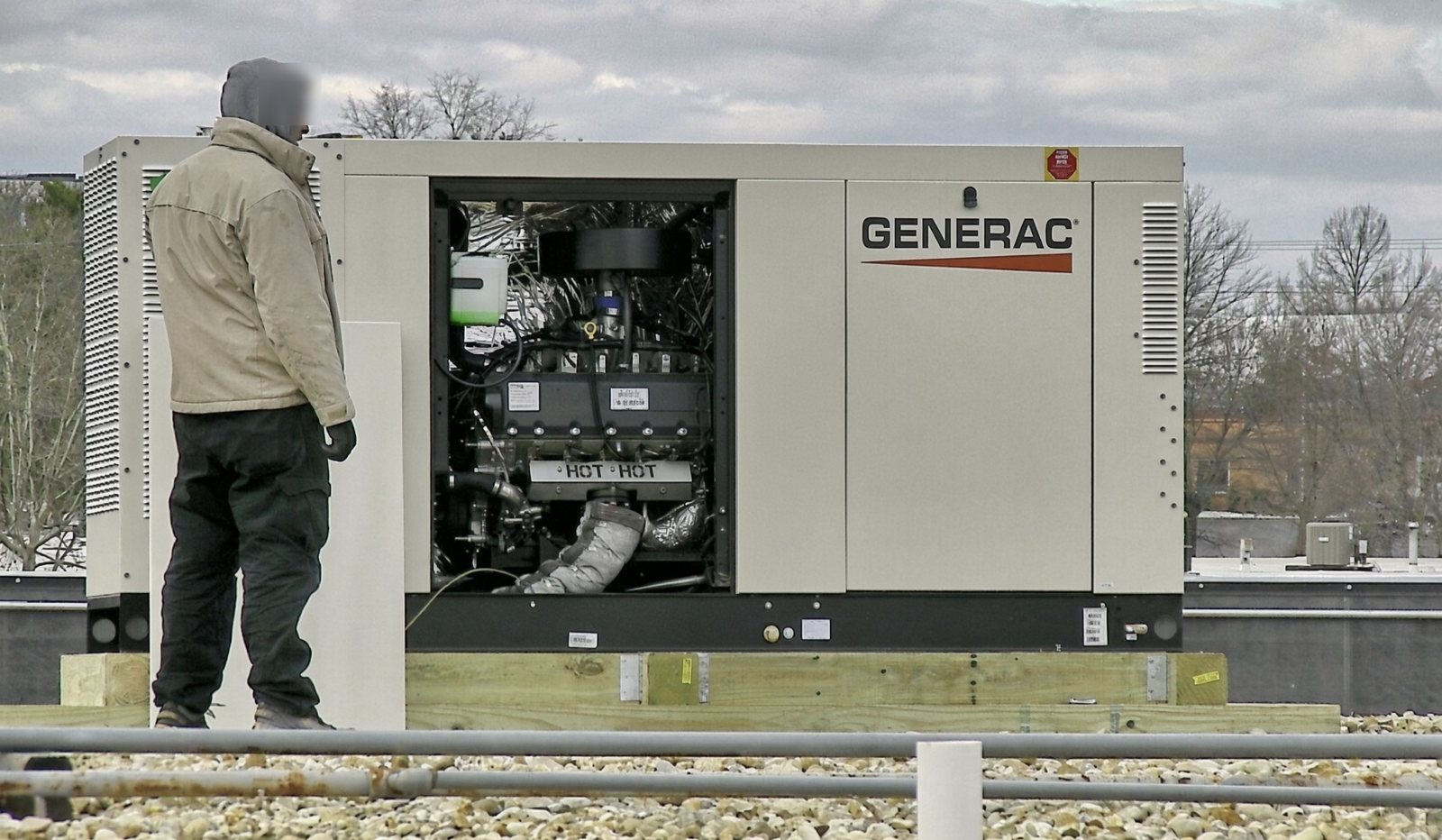
A generator does not replace batteries. It takes time to start, so batteries and UPS units carry the system until it does.
- Exercise. Generac standby generators run a scheduled self-test, set to weekly, every two weeks or monthly (Generac).
- The generator has a battery too. Generac says to inspect it once a year and that these batteries last about three to five years (Generac).
- Building transfer switch. An automatic transfer switch at the electrical service disconnects utility power and connects the generator during an outage, so the two never feed the building at the same time (Generac).
- Rack-mount transfer switch. A smaller device in an equipment rack that feeds a single-cord device, such as a recorder or controller, from two sources and switches between them if one fails (Eaton).
Before winter, confirm which circuits the generator actually feeds. Security panels and door power supplies are sometimes left off the generator panel. For generator and transfer switch work, we bring in our partner electrical contractors.
Gate Operators and Solar Power
Gate operators have batteries too, and they work in the cold. If a gate slows down or stops opening fully on a cold morning, test its batteries first.
Where there is no power at the gate, a solar kit can run it. RBD Security installs LiftMaster solar panels on solar-capable operators. A few points from LiftMaster’s own guidance:
- LiftMaster’s solar kit is a 10-watt, 12-volt panel, model SP10W12V (LiftMaster), and operators take from one to several panels depending on the model.
- The number of gate cycles a day depends on hours of sunlight. LiftMaster’s solar reference guide rates operators by sunlight zone and calls for 33 Ah batteries in place of the standard 7 Ah where temperatures stay below freezing for more than two weeks (LiftMaster solar reference guide).
- Winter is the hard season for solar: short days, low sun and cold batteries. Keep panels clear of leaves and snow, and trim anything that shades them.
Our comparison of LiftMaster and DoorKing gate operators has more on choosing an operator.
A Pre-Winter Checklist
- Find the install date on every battery. No date, or older than five years: replace it.
- Have each battery capacity-tested.
- Check that every transformer and power supply is on an outlet that is always on.
- Run a short outage test on the alarm, the doors and the gate.
- Check the UPS battery date and its run time under today’s load.
- Confirm the generator’s exercise schedule and its battery.
- Clear and inspect solar panels.
Our guide to winter lock problems covers the mechanical side of cold weather.
Frequently Asked Questions
How often should backup batteries be replaced?
Plan on every four to five years for sealed lead-acid batteries, sooner in hot locations, and whenever a capacity test shows the battery has dropped well below its rating.
My panel shows no low-battery warning. Is the battery fine?
Not necessarily. A battery can hold a normal voltage on charge and still have lost a third or more of its capacity, like the one in our photo. Only a capacity test shows that.
Can I replace the battery myself?
On a simple home alarm panel, an owner can often swap a like-for-like battery. Match the voltage and amp-hour rating, watch the polarity and recycle the old battery. For access control power supplies, gate operators and fire alarm panels, have a technician do it and test the system afterward.
What happens to my doors when the battery runs out?
It depends on the lock. Some unlock without power and some stay locked, and exit from the inside should work either way. Ask us to walk through each door so there are no surprises.
Schedule a Battery Check
Call RBD Security at (202) 709-9466 or request a quote. We test and replace backup batteries in alarm, access control, intercom, UPS and gate systems across Washington, DC, Maryland and Northern Virginia.