

Every January the same calls come in: the key will not turn, the door will not latch, or the keypad lock went dark on the coldest night of the year. Most of these are not broken locks. They are cold-weather problems with a door, a cylinder or a battery, and many of them can be prevented in an afternoon in November. Here is what goes wrong, what you can safely do yourself, and when to call a locksmith.
Why the Key Will Not Turn
A deadbolt cylinder “freezes” in two different ways, and they need different fixes.
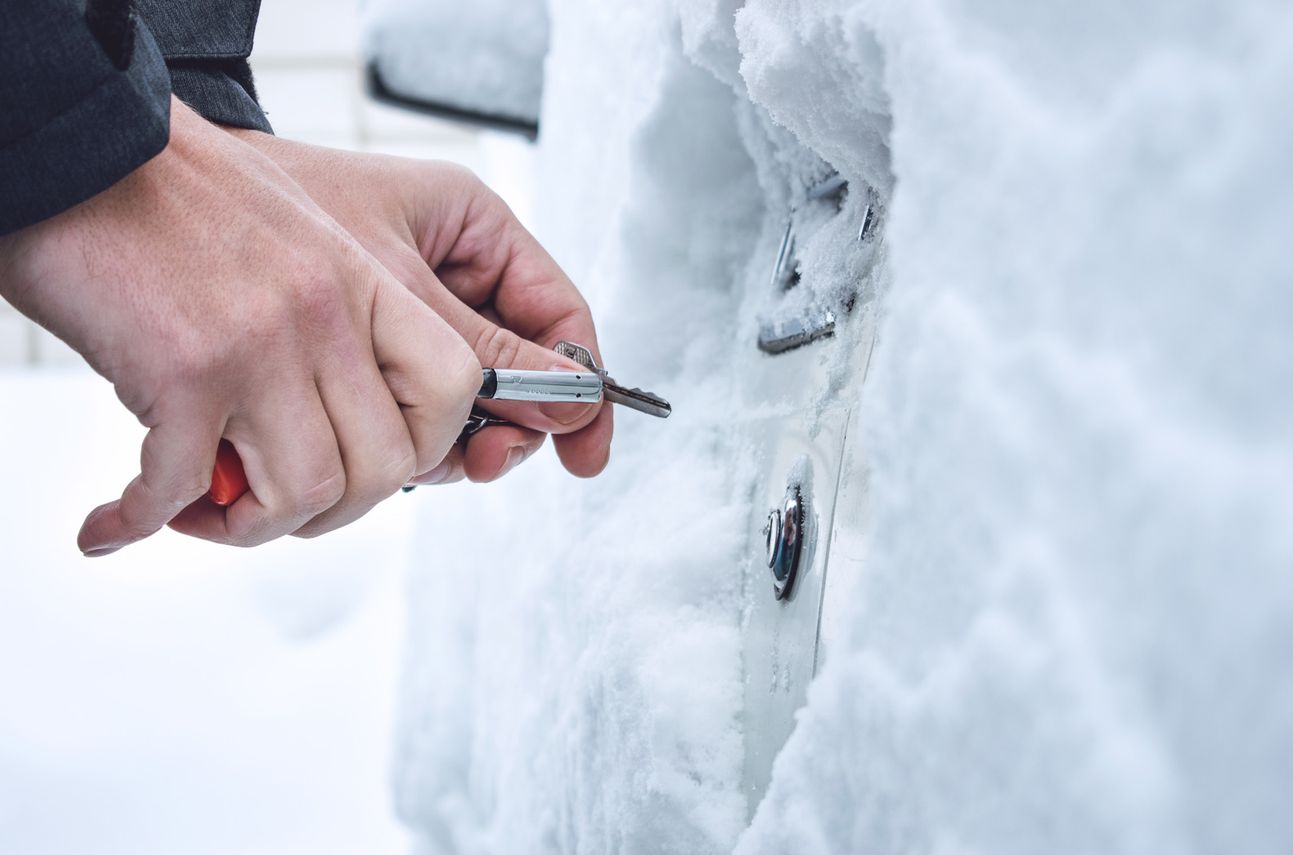
Ice in the keyway. Moisture gets into the cylinder from rain, melting snow or condensation, then freezes overnight. The key goes in part way or not at all, or it goes in and will not turn. This is most common on exposed doors, garage side doors and gate locks.
Gummed-up pins. Old grease, dirt and the wrong lubricant thicken in the cold. The key goes in but turns stiffly or not at all, and the problem gets worse as the temperature drops. This happens on doors that have never been serviced and on locks someone once sprayed with a household oil.
What to do:
- For ice, warm the key with your hands or a lighter for a few seconds, then insert it gently. Heat the key, not the lock. A commercial lock de-icer (an alcohol-based spray) works too. Do not pour hot water on the lock; it refreezes and gets into the door.
- For stiff pins, use a dry lubricant made for locks: graphite or a PTFE-based lock lubricant. A short puff into the keyway, then work the key in and out a few times.
- Do not use WD-40 or household oil. They clean briefly, then attract dirt and thicken in the cold, and you will be back where you started by February.
- Never force a stiff key. Keys snap in cold cylinders, and a broken key extraction costs more than the service call you were avoiding.
If the key turns freely but the bolt will not move, the problem is probably the door, not the cylinder. Keep reading.
Why the Door Will Not Latch or the Bolt Will Not Throw
Wood swells with moisture and shrinks in dry cold. Metal frames contract. A door that fit perfectly in September can bind at the top in a damp November and then rattle in a dry January. When the door moves, the bolt no longer lines up with the strike plate, and the deadbolt will not throw fully or at all.
Signs it is the door:
- You have to lift or push the door to lock it.
- The bolt goes most of the way and stops.
- The latch clicks only when you slam the door.
- Daylight shows around the edge of the door on one side.
Fixes, from simplest:
- Tighten the hinge screws. A sagging door is most often a loose top hinge. Replace one screw per hinge with a 3-inch screw that reaches the stud behind the jamb.
- Adjust the strike plate. A file and a few minutes can open the strike hole enough for the bolt to seat. If it needs more than a sixteenth of an inch, move the plate.
- Check the weatherstripping. New or thick weatherstripping can hold the door off the frame so the bolt cannot reach the strike. Compress it or choose a thinner profile.
- Look at the threshold. An adjustable threshold set too high lifts the door bottom and tilts it.
Test with the door open. If the deadbolt is stiff even then, the bolt mechanism is dirty or worn. Lubricate the bolt with the same dry lubricant, and if that does not fix it, the lock is due for replacement. Our guide to rekeying or replacing locks covers when a repair is worth it and when a new lock is.
Keypad and Smart Locks in the Cold
Battery-powered keypad and smart locks are the most common winter lockout we see, for one reason: alkaline batteries lose capacity in the cold and the lock’s low-battery warning arrives later than you would like. Then a cold night finishes them.
To avoid it:
- Replace the batteries in November, before the low-battery warning. A fresh set of good alkaline or, where the manufacturer allows, lithium batteries will usually last the winter.
- Know your backup entry. Most keypad locks have a mechanical key override or a way to jump-start the lock with a 9-volt battery held to contacts on the outside. Find out which yours has before you need it, and keep the override key somewhere other than inside the house.
- Check the rating. Not every smart lock is rated for an exposed, unheated door. Garage side doors, gate locks and storm-door-less entries in a north-facing alley get colder than the lock’s rated range.
- Keep the keypad dry. A small drip cap or a storm door keeps freezing rain off the keypad and the battery compartment.
For a gate, a mechanical keypad lock with no battery at all avoids the problem entirely. Our post on pedestrian gate locks compares mechanical, electric, solar and battery options.
Garage Doors, Gates and Side Doors
Side doors, basement doors and gates get the worst of the weather and the least attention. A few things that help:
- A weather cover or keyhole cover on any exposed cylinder keeps rain and snow out of the keyway.
- Gate locks should be lubricated with a dry lubricant in the fall and checked after the first freeze. Closers and spring hinges stiffen in the cold; a gate that stops latching in winter is often a closer that needs adjustment.
- Automated gates need a battery check before winter. Backup batteries age fast in the cold, and a gate with a dead battery during an outage is stuck in whatever position it was in.
- Garage door openers have a lock or a manual release; make sure the release cord is reachable and that the side door has its own working deadbolt, since the garage is often the easiest way into a rowhouse.
A November Checklist
Fifteen minutes per door, once a year:
- Puff dry lubricant into every exterior cylinder and work the key.
- Throw every deadbolt with the door closed and confirm it goes all the way.
- Tighten hinge screws and check for sag.
- Replace keypad and smart-lock batteries; test the key override.
- Lubricate gate locks, closers and hinges.
- Check that storm doors and weatherstripping are not holding the main door off the frame.
- Make sure a spare key exists somewhere other than inside the house.
When to Call a Locksmith
Call when the key is broken off in the cylinder, when the bolt is stuck in the locked position, when the door has moved enough that filing the strike will not fix it, or when a keypad lock will not respond to fresh batteries or the override. Those are a service call, not a DIY job, and forcing them usually turns a short service call into a new door.
How RBD Security Handles Winter Lock Calls
RBD services residential and commercial locks across Washington, DC and the Maryland and Virginia suburbs. For a stuck or frozen lock we start non-destructively: clear the keyway, free the bolt, extract a broken key, or open the door and then fix what caused it. Most winter calls end with a cleaned and lubricated cylinder, a re-set strike plate, or a replaced deadbolt, plus fresh batteries in the keypad lock. If you are locked out, our lockout guide explains what to expect and what to have ready, and our emergency locksmith service runs year-round.
Frequently Asked Questions
What is the best lubricant for a frozen or stiff lock?
A dry lock lubricant: graphite or a PTFE-based spray made for locks. Avoid WD-40 and household oils, which attract dirt and thicken in the cold.
Why does my door only lock when I lift it?
The door has sagged or the frame has moved with the weather, so the bolt no longer lines up with the strike plate. Tighten the hinges first, then adjust the strike.
My keypad lock is dead. How do I get in?
Most have a mechanical key override, and many can be jump-started by holding a 9-volt battery to contacts on the outside of the lock. Check your model’s manual, and keep the override key outside the house.
Can cold weather damage a lock permanently?
Rarely by itself. Damage usually comes from forcing a frozen key, which snaps the key or bends the cam, or from water freezing inside a cylinder that was already dirty. Keep the keyway dry and lubricated and the lock will outlast the door.
Beat the First Freeze
Call RBD Security at (202) 709-9466 to schedule a pre-winter lock service, a stuck-door repair or a keypad lock battery and override check, in Washington, DC, Maryland and Northern Virginia.